How often should a septic tank be pumped?
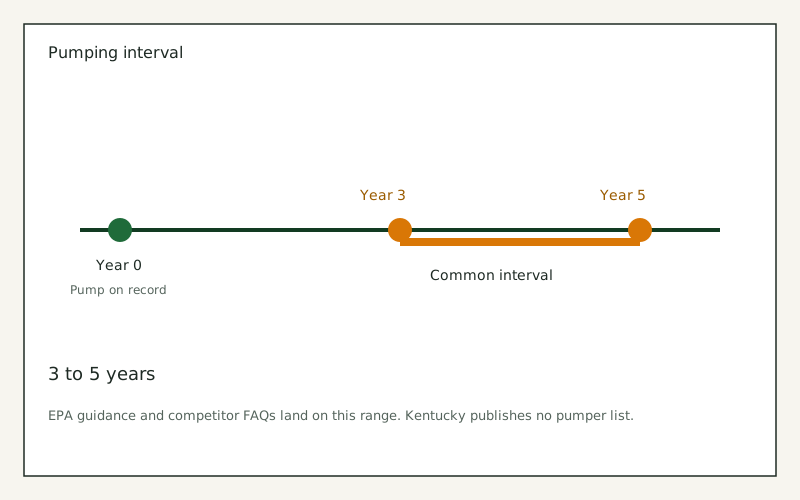
Pumping interval
3 to 5 years
Every 3 to 5 years is the interval EPA guidance and the Kentucky competitor FAQs both give. A house with heavy use, including a lake house full all summer, tends toward the shorter end. Kentucky publishes no pumper list.
Why the interval is a range
Household size, what goes down the drain, and how long a house sits empty all move a tank inside the 3 to 5 year span. The graphic on this page draws that span and states that Kentucky publishes no pumper list.
KREC Form 402 asks sellers for the date the tank was last cleaned. That date is how a buyer checks whether the interval has been kept. Cleaning is the form's word for the same visit.
The published cost, kept separate
SepticSeeker publishes $250 to $400 as a typical Kentucky pumping cost, and $295 to $425 with a $355 average on its cost page. Both are published estimates recorded Nov 20, 2026. The interval and the price answer different questions.
An Angi average sometimes quoted for Kentucky is left off this page, because that figure does not appear in Angi's own guide.
Lake houses and clay-country springs
Houses on Lake Cumberland and Lake Barkley often sit quiet in winter and work hard in summer. Owners of those houses read the 3 year end of the range more often. The installer lists for those counties are still installer lists.
Spring rain on clay, especially in McCreary and Wayne, is when slow drains show up. A wet yard can be a pumping issue or a field issue. The symptom guide covers the signs. This page covers the calendar.
Kentucky specifics
Kentucky publishes no pumper list anywhere this project could find. The directory claims installer coverage: 258 records, 22 counties, checked Nov 21, 2026. Asking a company whether they pump is a phone call, and the district lists cannot answer it.
District permit fees are not a pumping charge. Lake Cumberland's $227 and $271, and Purchase's $250, $250, and $170, are application fees for evaluation and permits.
See installers listed in your county
Adair County
24 installers with certification numbers on the Lake Cumberland District list dated Oct 7, 2026.
Anderson County
14 installers with certification numbers on the Anderson County list dated Mar 26, 2025.
Ballard County
3 installers on the Purchase District list dated Jan 15, 2026.
Caldwell County
7 installers on the Pennyrile District list dated Jun 2, 2021.
Carlisle County
5 installers on the Purchase District list dated Jan 15, 2026.
Casey County
16 installers with certification numbers on the Lake Cumberland District list dated Oct 7, 2026.
Clinton County
20 installers with certification numbers on the Lake Cumberland District list dated Oct 7, 2026.
Crittenden County
3 installers on the Pennyrile District list dated Jun 2, 2021.
Cumberland County
12 installers with certification numbers on the Lake Cumberland District list dated Oct 7, 2026.
Franklin County
15 installers on the Franklin County list dated Aug 13, 2026.
Fulton County
2 installers on the Purchase District list dated Jan 15, 2026.
Green County
8 installers with certification numbers on the Lake Cumberland District list dated Oct 7, 2026.
Hickman County
2 installers on the Purchase District list dated Jan 15, 2026.
Livingston County
2 installers on the Pennyrile District list dated Jun 2, 2021.
Lyon County
3 installers on the Pennyrile District list dated Jun 2, 2021.
McCracken County
9 installers on the Purchase District list dated Jan 15, 2026.
McCreary County
11 installers with certification numbers on the Lake Cumberland District list dated Oct 7, 2026.
Pulaski County
41 installers with certification numbers on the Lake Cumberland District list dated Oct 7, 2026.
Russell County
12 installers with certification numbers on the Lake Cumberland District list dated Oct 7, 2026.
Taylor County
19 installers with certification numbers on the Lake Cumberland District list dated Oct 7, 2026.
Trigg County
10 installers on the Pennyrile District list dated Jun 2, 2021.
Wayne County
20 installers with certification numbers on the Lake Cumberland District list dated Oct 7, 2026.
Questions on this guide
How often should a septic tank be pumped in Kentucky?
Every 3 to 5 years, the interval in EPA guidance and in the Kentucky FAQs recorded Nov 20, 2026. Heavy summer use at a lake house pushes toward 3 years. Kentucky publishes no pumper list.
How much does that pumping cost?
SepticSeeker publishes $250 to $400 typical, and $295 to $425 with a $355 average. Published estimates recorded Nov 20, 2026. The cost guide on this site walks through both figures.
What word does the seller form use?
Cleaned. KREC Form 402 asks for the date the tank was last cleaned, plus the servicer name and the last inspection date. Homeowners search the word pumping for the same visit.
Can the county roster tell me who pumps?
The roster tells you who is on the installer list. Pumping is not a field in the Nov 21, 2026 lists. The cards in Lake Cumberland and Anderson show certification numbers. The other districts show names and phones.
Sources: 3 to 5 year interval from EPA guidance and competitor FAQs, recorded Nov 20, 2026. SepticSeeker pumping ranges, same date. KREC Form 402. District lists checked by TankChecked on Nov 21, 2026. Kentucky publishes no pumper list.